Which Parts of Mediterranean Diet Health Claims Actually Have the Strongest Evidence
Quick Answer: Not every Mediterranean diet health claim rests on equally strong evidence. Cardiovascular outcomes are backed by some of the largest, longest randomized trials in nutrition science. Cognitive benefits are real and accumulating but rest on a smaller, more mixed body of research. Popular coverage bundles the two, which makes the evidence look more uniform than it is.
The Mediterranean diet has earned its reputation. That part isn’t in dispute.
What happens next is: an eating pattern with genuinely strong evidence in one area gets described as having strong evidence in every area, and the distinction quietly disappears from the wellness coverage.
This is general information, not medical advice.

Why Do Some Mediterranean Diet Claims Have Better Evidence Than Others?
Because research attention hasn’t been distributed evenly, and it never is.
Cardiovascular outcomes were studied first, studied most, and studied with the best available designs — large randomized controlled trials running over years, with hard endpoints like heart attacks and strokes. That’s the highest-quality evidence nutrition science produces, and there’s a lot of it here.
Other claims came later and have been studied with smaller samples, shorter follow-up, or observational designs that can show association but not causation. That’s not a knock on the researchers; it’s what a younger research area looks like.
The problem is the bundling. Popular coverage takes a pattern with one very strong evidence category and describes the whole thing as “the most evidence-backed diet,” which readers reasonably interpret as every claim being equally solid. The framing is technically defensible and practically misleading.
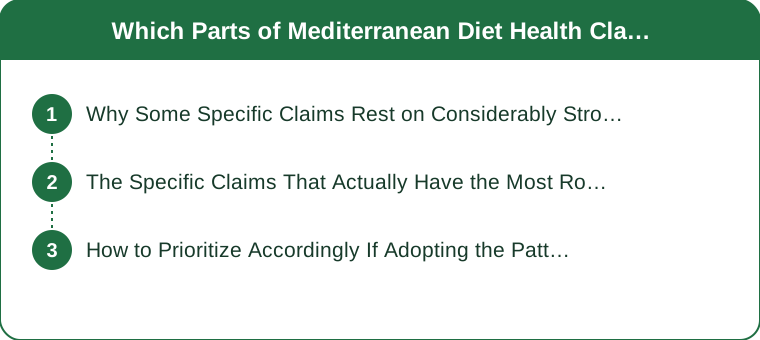
Which Claims Actually Have the Strongest Support?
Cardiovascular health: the strongest tier by a clear margin. This is where the largest and longest-running randomized controlled trials in all of nutrition science sit. If you’re adopting the pattern for heart health, you’re standing on the most solid ground available in dietary research — not just for this diet, but relative to dietary evidence generally.
Cognitive health: real, accumulating, but a smaller body of work. The findings are more mixed and the research base is considerably younger. Reasonable to consider, honest to describe as promising rather than established. Calibrate expectations accordingly.
General overall health: well supported indirectly. The pattern emphasizes vegetables, legumes, whole grains, fish, and olive oil while limiting ultra-processed foods — a profile that aligns with broad nutrition consensus regardless of what any single trial shows.
Where the language gets loosest: specific claims about weight loss, longevity, and inflammation. Not necessarily wrong — but these tend to be stated with more confidence than the underlying research supports, and they’re where marketing language does the most work.

Myth vs. Fact
Myth: Every Mediterranean diet health claim is backed by strong trial evidence. Fact: Cardiovascular outcomes are. Other claims sit on considerably thinner ground, and lumping them together overstates the weaker ones.
Myth: Olive oil is the active ingredient. Fact: The evidence supports the pattern, not any single component. Adding olive oil to an otherwise unchanged diet isn’t what was studied.
Myth: It’s a weight loss diet. Fact: It wasn’t primarily studied for weight loss, and it isn’t calorie-restricted by design. Some people lose weight on it; that’s not what the strong evidence is about.
Myth: “Evidence-based” means proven for you specifically. Fact: Trial results describe population-level averages. Individual response varies, which is why a doctor or dietitian who knows your situation is genuinely useful here.
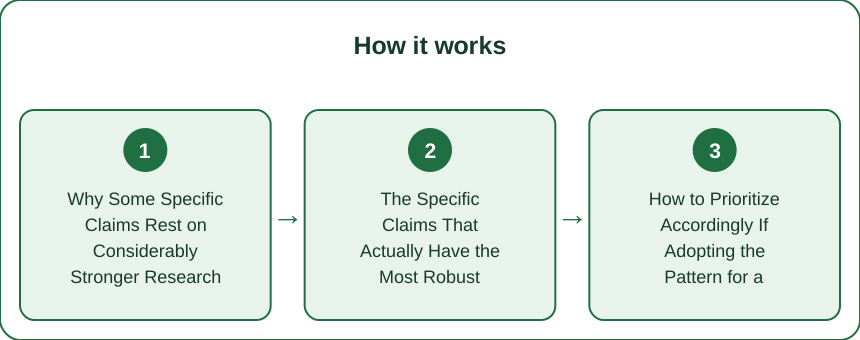
How Should You Prioritize If You’re Adopting It?
If cardiovascular health is your goal: proceed with genuine confidence. This is the best-supported dietary intervention available for that purpose, and the evidence quality is high enough that you’re not making a bet.
If cognitive health is your goal: it’s a reasonable choice with a plausible mechanism and accumulating support. Just hold the expectation loosely, and don’t let a cognitive-health framing be the only reason you commit — because if the results are less dramatic than the coverage promised, you’ll abandon a pattern that was doing you good elsewhere.
If you just want to eat better generally: adopt it broadly and stop optimizing. Even the more mixed claims sit within a pattern that’s well supported overall, so you’re not exposed to much downside.
Practical starting points, since the pattern is easier to adopt in pieces than all at once:
- Olive oil as your default cooking fat
- Fish twice a week
- Legumes several times a week
- Vegetables at most meals
- Less red and processed meat
Two or three of those, sustained, beats a complete overhaul abandoned in March.
And the honest framing: diet is one input among several. Sleep, activity, and stress all matter, and the trials that produced this evidence generally studied people living whole lives rather than diets in isolation. Building activity in doesn’t need to be complicated — a daily walk in comfortable high waist leggings is a perfectly serious intervention.
When to see a professional: if you’re managing cardiovascular disease, diabetes, or kidney conditions, or taking medication affected by diet, work with a doctor or registered dietitian rather than adopting a pattern independently. This is general information, not medical advice.
FAQ
Is the Mediterranean diet good for weight loss?
It can support it, but weight loss isn’t where its strongest evidence lies and it isn’t calorie-restricted by design. If weight loss is the goal, that’s worth discussing with a dietitian specifically.
Do I need to eat fish to follow it?
Fish is a notable component of the pattern studied, so omitting it means you’re following a modified version. Plant-based adaptations exist and are reasonable, but they haven’t been tested as extensively.
Is olive oil alone enough to get the benefits?
Unlikely. The evidence supports the whole dietary pattern, and no single component has been shown to carry the effect on its own.
TL;DR
- Cardiovascular claims have the strongest support — large, long randomized trials with hard endpoints.
- Cognitive claims are real but rest on a smaller, more mixed body of research.
- Popular coverage bundles them, making the evidence look more uniform than it is.
- Adopt confidently for heart health, with calibrated expectations for cognition, and broadly for general health.
- Work with a doctor or dietitian if you’re managing a chronic condition or on diet-sensitive medication.
Keep Reading
This article is for general informational purposes only and is not medical advice. Always consult a qualified health professional for guidance specific to you.