Why Mediterranean Eating Gets Easier in Autumn, Not Harder
Quick Answer: The Mediterranean pattern is usually pictured as tomatoes, cucumbers and grilled fish, which is a summer snapshot of a year-round way of eating. Autumn is when its core foods are at their easiest: legumes, whole grains, brassicas, root vegetables, nuts and olive oil are all cheap, storable and better suited to the slow, one-pot cooking people actually want when the evenings get cold.
The pattern does not require summer produce. It requires legumes, olive oil and vegetables, and autumn supplies all three abundantly.
If your version of this collapsed last October, the problem was probably that you were trying to eat July food in October.

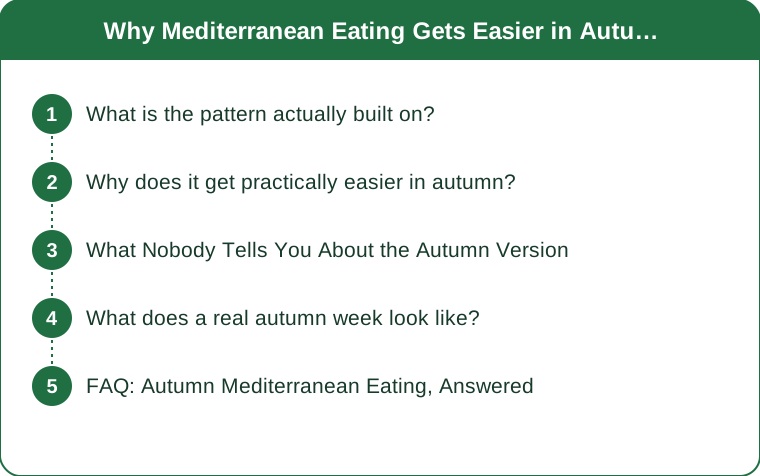
What is the pattern actually built on?
The traditional Mediterranean pattern, as described in the research literature, is characterised by a high intake of vegetables, fruit, legumes, nuts, seeds and whole grains, olive oil as the principal fat, moderate fish and dairy, and low intakes of red and processed meat.
Notice what is not on that list. No specific vegetable is required. Nothing about the pattern depends on tomatoes being in season.
Legumes carry more of the pattern than salad ever did. Beans, lentils and chickpeas are a defining feature, and they are a cold-weather food in practice, appearing in soups, stews and braises across the whole region.
Whole grains work the same way. Barley, farro, bulgur and brown rice are the base of many autumn and winter dishes.
Olive oil does not have a season. It is the constant, and the autumn olive harvest is when the new season’s oil actually appears.
And the vegetable emphasis simply moves. Cabbage, cauliflower, fennel, leeks, squash, chard and every root vegetable are all in season in autumn in the northern hemisphere and all fit the pattern exactly.
Why does it get practically easier in autumn?
The cooking method matches the weather. Nobody wants to stand over a hot grill in January and everybody is happy to leave a pot of beans simmering. Autumn food is naturally one-pot food, and one-pot food is naturally batch food.
Legumes are cheap and shelf-stable. Dried beans and lentils cost very little per serving, store for a year, and require no shopping discipline whatsoever. A summer pattern built on fresh perishables demands two or three grocery trips a week; a legume-based one demands almost none.
Roasting is forgiving. Autumn vegetables roast well, taste better roasted than raw, and tolerate being made in advance. Summer vegetables mostly do not.
Batch cooking works better with these foods. Stews and braised legume dishes genuinely improve overnight, which is unusual and extremely convenient.
Appetite goes up as it gets colder, and this pattern handles that gracefully because the meals are substantial. Many people find summer versions of it leave them hungry, which is a real reason adherence drops.
And the shopping gets simpler. Onions, garlic, tinned tomatoes, dried legumes, olive oil, a hard cheese and whatever vegetable is cheapest that week is a complete list. It is far easier to sustain than a summer produce rotation.

What Nobody Tells You About the Autumn Version
Tinned legumes are not a compromise. They are used constantly in the region itself. Rinsing them reduces the sodium meaningfully, and the convenience difference is what keeps the habit alive on a Tuesday.
Tinned tomatoes usually beat fresh out of season. They are picked and processed at ripeness, so for anything cooked they are the better ingredient for most of the year, not a substitute.
Olive oil quantity is where most people quietly deviate. The pattern uses a lot of it, and in cooked autumn dishes the oil is a primary ingredient rather than a coating. Under-oiling is the most common way an authentic dish ends up tasting flat.
The bean cooking liquid is an ingredient. Starchy legume liquid thickens and enriches a stew. Draining it all away and adding water instead is why a home version can taste thinner than the same dish elsewhere.
Nuts are the autumn snack the pattern actually contains. Walnuts and almonds appear throughout, and autumn is when the harvest arrives.
And the fish does not have to be fresh. Tinned sardines, anchovies and tuna are traditional, affordable and completely on-pattern, which matters in the months when a fresh fish counter is less appealing.
One caveat worth stating: any pattern change alongside a medical condition or medication is worth raising with a doctor or a registered dietitian. This is general information, not medical advice.
What does a real autumn week look like?
Anchor it on two batch dishes. One legume-based stew and one roasted vegetable and grain tray, made once, eaten across several days with different accompaniments. That is most of the week solved in about ninety minutes.
Lentil and vegetable soup with good olive oil stirred in at the end. The finishing oil is not optional decoration; it is a large part of both the flavour and the pattern.
Chickpeas with greens. Chard, spinach or cabbage cooked down with garlic, chickpeas and oil is a complete, cheap and genuinely traditional dinner in about twenty minutes.
A roasted squash and barley tray, dressed while warm so the grain absorbs the dressing, with walnuts and a hard cheese added at serving.
Tinned fish for the fast meals. Sardines on wholegrain toast with lemon and oil is a five-minute meal that fits the pattern precisely.
Fruit and nuts rather than a formal dessert, which is how the pattern actually treats sweetness most of the time. Autumn brings apples, pears and figs.
Keep the store cupboard stocked and the rest gets easy: dried and tinned legumes, tinned tomatoes, whole grains, olive oil, garlic, onions, nuts, tinned fish and a hard cheese. With that in the house, you are never more than twenty-five minutes from an on-pattern dinner regardless of what is in the fridge.
FAQ: Autumn Mediterranean Eating, Answered
Is the Mediterranean diet a summer diet?
No. It is a year-round regional pattern. The summer image is a marketing snapshot rather than a description of how it is eaten.
Are tinned beans acceptable?
Yes, and they are widely used. Rinsing reduces sodium; the convenience is what keeps the habit going.
Do I have to eat fish?
Moderate fish is part of the pattern, and tinned fish counts. Plant-based adaptations that lean harder on legumes are still recognisably the same pattern.
How much olive oil is normal?
More than most adaptations use. It is the principal fat, used both in cooking and poured over food at the table.
Is this expensive?
The legume-and-grain core is among the cheapest ways to eat. The costs come from imported produce and large amounts of fish, which are the least essential parts.
Will it work with a slow cooker?
Very well. Legume stews and braises are exactly what slow cookers are good at, which makes autumn the easiest season to run this on autopilot.
TL;DR:
- The Mediterranean pattern is defined by legumes, vegetables, whole grains, nuts and olive oil, not by summer salad.
- Autumn produce, brassicas, roots, squash and greens, fits the pattern exactly.
- Legume stews are cheap, storable, batch-friendly and actually improve overnight.
- Tinned legumes, tinned tomatoes and tinned fish are traditional, not compromises.
- Under-using olive oil is the most common way a home version tastes flat.
- Keep a small store cupboard stocked and dinner is always about twenty-five minutes away.
Summer was the photo shoot. Autumn is where the pattern actually lives.
Keep Reading
This article is for general informational purposes only and is not medical advice. Always consult a qualified health professional for guidance specific to you.