Why the Mediterranean Diet Doesn't Work the Same for Everyone
Quick Answer: Baseline diet quality before switching, portion sizes of olive oil and healthy fats, and individual metabolic and gut microbiome differences all affect how strongly someone responds to a Mediterranean diet. Someone starting from a highly processed diet typically sees more dramatic benefit than someone already eating reasonably well.
The Mediterranean diet has some of the strongest research backing of any eating pattern, yet two people following it closely can see quite different individual results.

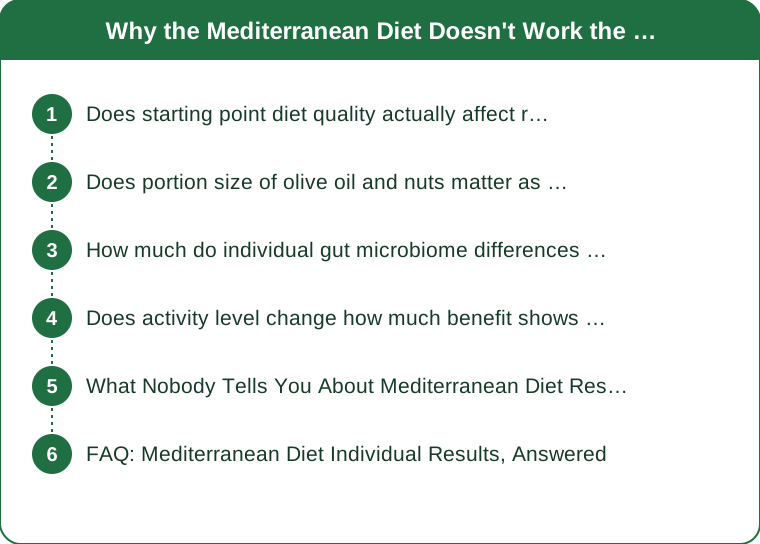
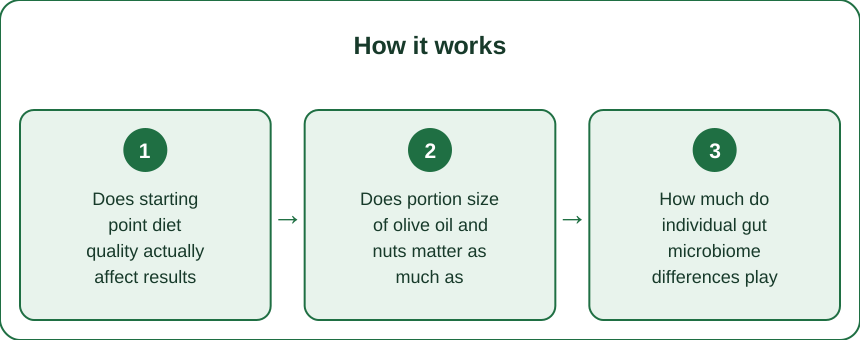
Does starting point diet quality actually affect results this much?
Yes — research on dietary interventions generally shows the largest measurable improvements in people moving from a highly processed baseline diet, while someone already eating a moderately healthy diet naturally sees a smaller relative shift when adopting Mediterranean principles.
Does portion size of olive oil and nuts matter as much as inclusion?
It does — much of the Mediterranean diet’s cardiovascular benefit research specifically studied particular quantities of olive oil and nuts, so including small token amounts rather than the studied portion sizes can produce meaningfully different results.
How much do individual gut microbiome differences play a role?
Emerging research suggests gut microbiome composition affects how efficiently individuals process certain plant fibers and polyphenols central to the Mediterranean diet, which may partly explain why identical eating patterns produce somewhat different metabolic responses between individuals.

Does activity level change how much benefit shows up?
Yes — much of the population-level research on the Mediterranean diet comes from populations with generally higher baseline physical activity, so diet alone, without any corresponding activity level, may show a more modest effect than the original studied context.
What Nobody Tells You About Mediterranean Diet Research
Some of the most cited Mediterranean diet research studied specific populations over long time periods, and translating those population-level findings to an individual’s shorter-term experience does not always produce identically dramatic results, even when followed accurately.
FAQ: Mediterranean Diet Individual Results, Answered
How long should someone try it before expecting to see results?
Most noticeable changes in markers like cholesterol or blood pressure take 8-12 weeks of consistent adherence, with some benefits building further over months.
Does genetics play a role in individual response?
Some research suggests certain genetic variants affect how individuals metabolize dietary fats, which may partly explain variable cholesterol responses to the same diet.
Is it still worth adopting even with variable individual results?
Yes — even a more modest individual response still generally represents an improvement over a more processed baseline diet for most measurable health markers.
TL;DR:
- Starting diet quality strongly affects how dramatic the Mediterranean diet’s benefits appear
- Actual portion sizes of olive oil and nuts matter as much as simply including them
- Individual gut microbiome and activity level differences likely affect the response too
- Variable individual results do not undermine its overall evidence-backed value
The Mediterranean diet’s strong research backing is real, but individual results reasonably vary based on starting point and several personal factors.
Keep Reading
This article is for general informational purposes only and is not medical advice. Always consult a qualified health professional for guidance specific to you.