Why Canned Fish Beats Fresh for Weeknight Mediterranean Eating
Quick Answer: Canned oily fish delivers most of what makes fish valuable in a Mediterranean pattern, at a fraction of the cost and effort of fresh, and the nutritional gap is far smaller than people assume. Sardines, mackerel, and anchovies are high in long-chain omega-3s, and canned sardines and salmon with bones are among the best non-dairy calcium sources available. The realistic comparison is not canned versus fresh. It is canned versus the fish you did not cook, and canned wins that comparison every time.
The advice is to eat fish twice a week. The research behind it is solid. And adherence to that specific recommendation is consistently the worst of any Mediterranean diet component in every survey that measures it.
The reason is not that people dislike fish. It is that fresh fish requires a trip, a plan, and cooking it the same day. The tin removes all three.

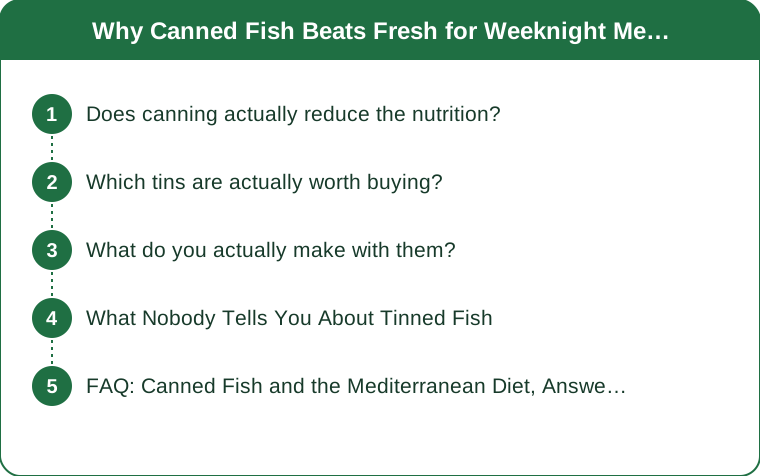
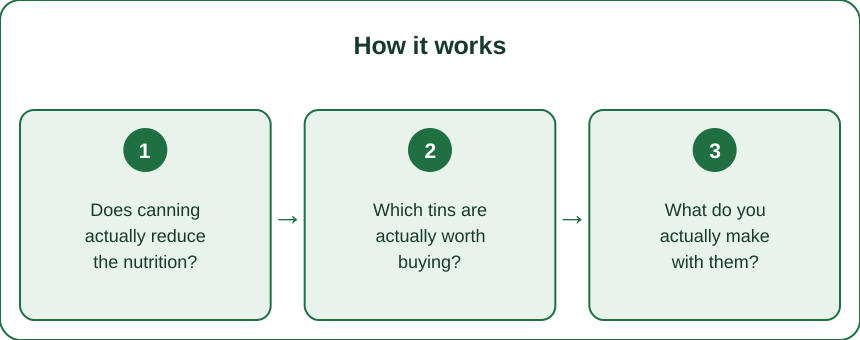
Does canning actually reduce the nutrition?
Less than you would expect, and in one case it improves it.
Omega-3 fatty acids survive canning well. EPA and DHA are heat-stable enough that the canning process retains the large majority. Canned sardines and mackerel are among the richest available sources of both, comparable per gram to fresh equivalents.
Protein is unaffected. Canning denatures protein without reducing its nutritional value.
Calcium goes up substantially. This is the improvement. Canning softens the small bones in sardines and canned salmon until they are edible, and those bones are calcium. A standard tin of sardines with bones supplies roughly 300 to 380mg of calcium, which is comparable to a glass of milk and unmatched by any fresh fish preparation, since nobody eats the bones of fresh fish.
What does decrease: some water-soluble B vitamins, particularly thiamine, drop during heat processing. This is a real loss and a small one in the context of a varied diet.
The sodium consideration. Canned fish is usually salted, at roughly 300 to 500mg per tin for sardines and considerably more for anchovies. Rinsing reduces it, and choosing no-salt-added versions removes the issue if you are managing blood pressure.
On the oil the fish is packed in. Fish packed in olive oil retains more omega-3 than fish packed in water, because some of the fish’s own fat migrates into the packing medium. If you drain water-packed fish you lose a little. If you drain oil-packed fish you lose a little more, so use the oil in the dish rather than discarding it.
Which tins are actually worth buying?
The category is wide and the useful part of it is narrow.
The high-value tins, in rough order:
- Sardines. The best overall value in the category. High in EPA and DHA, high in calcium with bones, very low in mercury because they are small and short-lived, and inexpensive. Roughly 1,000 to 1,500mg of combined omega-3 per tin.
- Mackerel. Similar omega-3 profile, larger fillets, stronger flavour. Excellent value and often cheaper than sardines by weight.
- Anchovies. Not a portion food, and a flavour tool. A few fillets melted into a sauce add savoury depth without tasting of fish, and this is the single most useful Mediterranean pantry item most people do not own.
- Salmon with bones. Good omega-3, excellent calcium, more expensive.
- Tuna. The most popular and the least interesting nutritionally. Skipjack and light tuna are low in mercury and low in omega-3 compared with oily fish. Albacore has more omega-3 and more mercury.
On mercury, briefly. Small, short-lived fish accumulate very little. Sardines, anchovies, mackerel of the Atlantic and Pacific varieties, and skipjack tuna are all in the low category. King mackerel is a different fish and is high, which causes confusion.
What to look for on the label: packed in olive oil, bones included if you want the calcium, and a species name rather than just a category. Brands that name the species tend to be sourcing more carefully.
Cost reality: at typical prices, a tin of sardines delivering a full portion of oily fish costs a fraction of a fresh fillet and keeps for years. Buying twelve tins is a two-minute decision that solves the twice-weekly recommendation for a month and a half.

What do you actually make with them?
The Mediterranean answer is barely cooking at all, which is the point.
Five assemblies that take under ten minutes:
1. Sardines on toast, properly. Good bread, toasted, rubbed with a cut garlic clove and a halved tomato until the bread is stained, then sardines, olive oil, lemon, and parsley. This is a standard meal across the northern Mediterranean and it takes four minutes.
2. Mackerel with white beans. Drained cannellini, tinned mackerel broken into chunks, red onion sliced thin, lemon, olive oil, plenty of parsley. Serve at room temperature. Improves after an hour.
3. Anchovy and tomato pasta. Four anchovy fillets melted in olive oil with garlic and chilli, tinned tomatoes, twenty minutes. The anchovies dissolve completely and the sauce does not taste of fish, it tastes deeply savoury.
4. Sardine and potato salad. Boiled new potatoes, sardines, capers, red wine vinegar, olive oil, dill. Holds well in the fridge for two days, which makes it a genuine meal prep option.
5. Tinned fish on a grain bowl. Whatever grain you have, something green, something acidic, and a tin. This is the lowest-effort version and it is the one that actually gets made on a Wednesday.
The pattern to notice: none of these involve cooking fish. The fish arrives cooked. What you are doing is assembling, which is a fundamentally different level of activation energy on a weeknight.
A note on frequency. Two tins a week meets the standard recommendation. If that feels like a lot of sardines, alternate mackerel and salmon, and use anchovies as a flavour base in dishes where they disappear entirely.
What Nobody Tells You About Tinned Fish
The bones are the point, and people pick them out. Removing the softened bones from sardines removes most of the calcium and is the single most common way people accidentally downgrade the food. They are entirely soft and disappear texturally in anything mashed or spread.
Tinned fish improves with age, within reason. Good sardines in olive oil are traditionally cellared for a year or more, turned occasionally, and the texture becomes softer and the flavour rounder. This is a real practice and not marketing.
Strong-smelling tins are usually the better fish. Sardines and mackerel smell like themselves. The mildest tinned fish in the aisle is usually the one processed hardest.
Draining oil-packed fish wastes the best part. The packing oil carries fat-soluble compounds from the fish. Pour it over the salad rather than into the sink.
The calcium comparison is genuinely surprising. A tin of sardines with bones supplies a comparable amount of calcium to a serving of dairy, with the addition of vitamin D and omega-3. For anyone reducing dairy, this is one of the very few genuinely equivalent swaps rather than a compromise.
Anchovy paste is not the same thing. It is convenient, and it usually contains added oil, salt, and sometimes vinegar, and it lacks the clean savoury effect of whole fillets melted into hot oil. Tinned or jarred fillets keep for months in the fridge under oil once opened.
The environmental angle runs the same direction. Small pelagic fish including sardines, anchovies, and mackerel are lower on the food chain, faster to reproduce, and generally better managed than large predatory species. The nutritionally best choice and the ecologically better choice happen to coincide, which is not usually how this works.
Seasonal note: as the weather cools, the room-temperature bean and fish assemblies give way to warm ones, and tinned fish stirred into a soup or a braise at the end of cooking works well. Add it in the final minute, off the heat, so it does not break apart.
This is general information, not medical advice. If you are pregnant, or managing a condition where sodium or mercury intake matters, follow the specific guidance you have been given.
FAQ: Canned Fish and the Mediterranean Diet, Answered
Is canned fish as healthy as fresh?
For omega-3 and protein, close to equivalent. For calcium, canned fish with bones is considerably better, since fresh fish bones are not eaten. Some B vitamins are reduced by heat processing.
Which canned fish is best for omega-3?
Sardines and mackerel, at roughly 1,000 to 1,500mg of combined EPA and DHA per tin. Tuna, particularly skipjack and light tuna, is much lower.
Should I worry about mercury in canned fish?
Not with small, short-lived species. Sardines, anchovies, Atlantic mackerel, and skipjack tuna are all low. Albacore tuna is higher, and king mackerel, which is a different fish, is high.
TL;DR:
- Canned oily fish retains most omega-3 and protein, and canned fish with bones supplies more calcium than any fresh preparation.
- Sardines and mackerel are the best value in the aisle. Anchovies are a flavour tool rather than a portion.
- The honest comparison is canned versus the fish you did not cook, and canned wins that easily.
- Buy twelve tins once and the twice-weekly recommendation stops requiring any planning.
Put two tins in the cupboard this week and make the toast version once. It takes four minutes and it settles the argument.
Keep Reading
This article is for general informational purposes only and is not medical advice. Always consult a qualified health professional for guidance specific to you.