Why Breakfast Is the Mediterranean Meal Americans Get Most Wrong
Quick Answer: Most American versions of a Mediterranean breakfast are a cereal-based, sweet, low-protein meal with a Mediterranean ingredient added on top. The traditional pattern is closer to the opposite: modest in size, savoury as often as sweet, built around dairy, olives, vegetables, eggs or legumes, with bread as a vehicle rather than the centre. The single largest gap is protein at breakfast, which is where most of the difference in how the morning feels comes from.
You put berries on your oatmeal and a drizzle of honey and call it Mediterranean. It is a perfectly reasonable breakfast. It is just not the one the research population was eating.
The distance between the two is small in ingredients and large in effect.

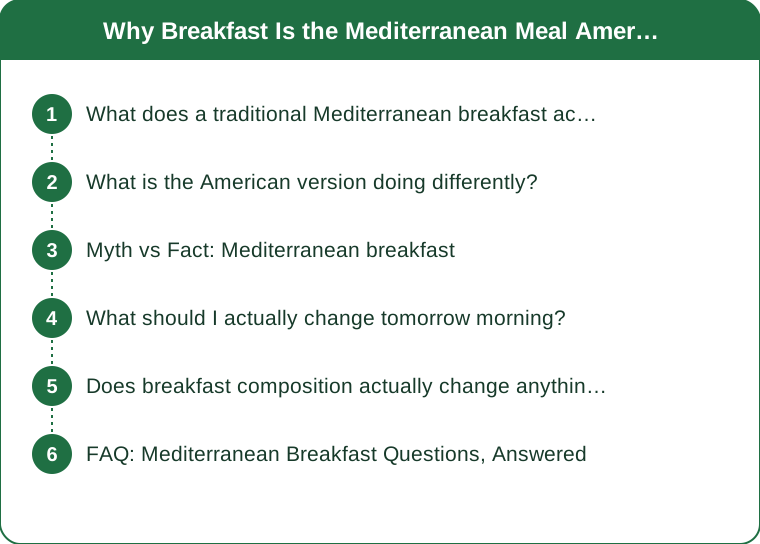
What does a traditional Mediterranean breakfast actually look like?
It varies enormously by country, which is the first thing worth saying, because there is no single canonical version.
Greece: often yogurt with honey and nuts, or bread with olives, tomato and a hard cheese. Sometimes very little at all, with a larger mid-morning bite.
Turkey: the most elaborate version, a spread of white cheese, olives, tomato, cucumber, eggs, sometimes a legume dish, with bread. Savoury from start to finish.
Spain: frequently minimal early on, then a mid-morning second breakfast of bread rubbed with tomato and olive oil, sometimes with jamon or a tortilla.
Southern Italy: genuinely light, often coffee with a small sweet pastry, and it is worth being honest that this one is not a protein-forward meal at all.
What runs through most of them: portion sizes are modest, savoury components are normal, olive oil appears in the morning rather than only at dinner, and the meal is rarely built on a sweetened grain.
Is coffee and a pastry really Mediterranean?
In parts of Italy, yes, and it is a reminder that the diet pattern as a whole matters more than any single meal. The pattern still works because of what happens over the rest of the day.
What is the American version doing differently?
Four specific substitutions, and each one seems small.
Grain becomes the base instead of the accompaniment. Oatmeal, cereal, toast, granola. In the traditional pattern bread is present but it is carrying something else, and the quantity is smaller.
Sweet displaces savoury by default. Honey exists in the Greek version, but so do olives, cheese and tomato. American Mediterranean breakfasts are almost entirely on the sweet side, which quietly removes the vegetables and much of the protein.
Protein drops. A bowl of oatmeal with fruit runs around 8 to 10 grams of protein. A plate with two eggs, cheese and olives runs 20 to 25. That gap is the single biggest functional difference between the two meals, and it shows up as hunger at 10:30.
Olive oil disappears from the morning. Traditional Mediterranean eating distributes olive oil across the whole day. American adaptations concentrate it at dinner, which changes both the satiety of the morning meal and the total intake.
Also worth naming: portion inflation. A Greek yogurt breakfast at home is often twice the volume of the traditional equivalent, and volume changes the meal even when the ingredients are right.
Myth vs Fact: Mediterranean breakfast
Myth: Mediterranean breakfast means yogurt with berries and honey. Fact: That is one version from one country. Savoury breakfasts with cheese, olives, eggs, tomato and cucumber are at least as traditional, and considerably more common across the region as a whole.
Myth: It has to be big to be healthy. Fact: Many Mediterranean breakfasts are small by American standards, with more eaten at midday. Total daily pattern is what the research measures, not breakfast size.
Myth: Bread is off limits. Fact: Bread is central across the entire region. What differs is quantity, what goes on it, and that it is usually a denser, less sweetened loaf.
Myth: Granola is a Mediterranean food. Fact: It is a North American invention and most commercial versions carry 12 to 20 grams of added sugar per serving. It is the ingredient most likely to be undermining an otherwise good bowl.
Myth: You need to give up eggs for heart health. Fact: Eggs appear regularly in traditional Mediterranean breakfasts across Turkey, Greece and Spain, and current dietary guidance for most people does not restrict them the way older advice did. Individual medical advice takes precedence over general patterns.

What should I actually change tomorrow morning?
Small, specific swaps that move the meal without rebuilding it.
- Add 15 to 20 grams of protein. Two eggs, a serving of Greek yogurt with real protein content, cottage cheese, or a piece of feta. This is the highest-value single change and it is the one that changes how 11am feels.
- Put a vegetable on the plate. Sliced tomato with olive oil and salt takes 30 seconds and is one of the most common breakfast items across the entire region.
- Move some olive oil to the morning. A tablespoon over eggs, on bread, or over tomato. Traditional intake is spread across the day rather than saved for dinner.
- Halve the sweetener. Honey is traditional. A tablespoon is traditional. Four is not.
- Swap granola for nuts. A small handful of walnuts or almonds delivers what granola is pretending to deliver, without the added sugar.
- Keep bread, change bread. A dense sourdough or wholegrain loaf, one slice, carrying something, rather than two slices of soft white as the meal itself.
What does a realistic weekday version look like?
Greek yogurt with walnuts and a small drizzle of honey, plus half a sliced tomato with olive oil. Four minutes, roughly 25 grams of protein, and much closer to the pattern than a bowl of granola.
Does breakfast composition actually change anything measurable?
The honest answer is that breakfast in isolation is one of the weaker-evidenced parts of nutrition, and most of the strong Mediterranean diet evidence is about the overall pattern rather than any single meal. But two things are reasonably supported.
Protein at breakfast improves satiety through the morning. Studies comparing higher-protein and lower-protein breakfasts fairly consistently find reduced hunger and reduced later eating with the higher-protein version. The effect is modest but real.
Meals with protein and fat produce a flatter glucose response than the same calories from refined carbohydrate alone. For most people this shows up as steadier energy rather than as anything dramatic.
What is not well supported: that skipping breakfast is harmful, that breakfast timing has large metabolic effects for most people, or that any particular breakfast food is uniquely beneficial.
The realistic framing: changing breakfast will not by itself produce the outcomes the Mediterranean diet research describes. Those came from a whole pattern over years. But breakfast is the meal most people have complete control over, it is the easiest one to change permanently, and getting it closer to the pattern is a cheap improvement with no downside.
This is general information, not medical advice. Speak to a professional about individual dietary needs.
FAQ: Mediterranean Breakfast Questions, Answered
Do I need to eat breakfast at all?
No. Plenty of the region eats very little in the morning. If you do eat it, composition matters more than the fact of eating it.
Is Greek yogurt from the supermarket the same thing?
Mostly, if it is genuinely strained and unsweetened. Check protein per serving, since some products labelled Greek style are thickened rather than strained and carry much less protein.
What about coffee?
Entirely traditional across the whole region. Milk and sugar are the variables worth watching, not the coffee.
Can I do this on a plant-based diet?
Yes, and much of the region already does. Legume dishes, tahini, nuts, tomato with olive oil and good bread cover it, though hitting 20 grams of protein takes slightly more deliberate assembly.
TL;DR:
- The American Mediterranean breakfast is usually grain-based, sweet and low in protein. The traditional versions are modest, often savoury, and built around dairy, eggs, vegetables and olives.
- The protein gap is the biggest functional difference, roughly 10 grams versus 25, and it shows up as mid-morning hunger.
- Move some olive oil into the morning, add a vegetable, halve the sweetener, and swap granola for nuts.
- Breakfast alone will not reproduce the research outcomes, but it is the easiest meal to permanently improve.
The change here is not a new shopping list. It is a shift from sweet grain with something added, to protein and vegetables with bread alongside, and it takes about the same four minutes.
Keep Reading
This article is for general informational purposes only and is not medical advice. Always consult a qualified health professional for guidance specific to you.