The Olive Oil Aisle, Decoded: Buying the Good Stuff Without the Markup
Quick Answer: Buy extra virgin only, look for a harvest date within the last 12–18 months, and insist on a dark bottle or tin. Those three checks beat region, price, and packaging design almost every time. Then run a two-oil kitchen: a good everyday extra virgin you pour generously, and one special bottle for finishing.
Olive oil is the Mediterranean pattern’s signature ingredient and the grocery store’s most confusing shelf. Virginities. Regions. Prices from $6 to $60 for bottles that look almost identical.
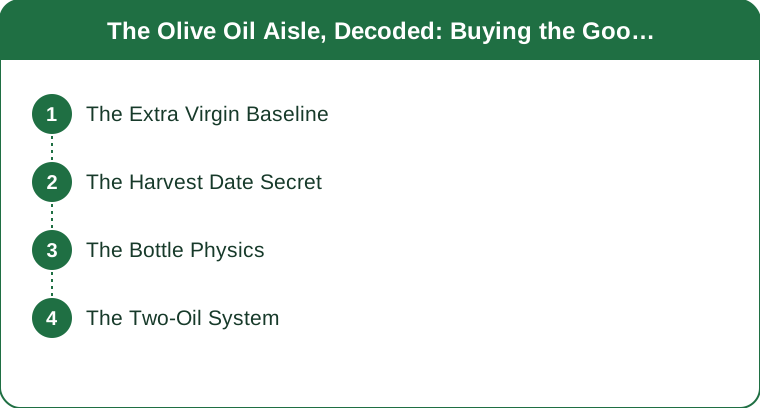
The good news: four label checks sort the entire aisle in about 90 seconds, and a two-bottle system at home ends the daily internal debate about whether this dish deserves the good oil.
What does extra virgin actually mean?
Mechanically pressed, unrefined, and passing a quality grade for both chemistry and taste.
That last part matters more than most people realize. Extra virgin isn’t a marketing adjective — it’s a defined grade requiring free acidity below 0.8% plus a sensory panel finding no defects. Everything below it has been refined, usually with heat or chemical solvents.
Why you should care: the polyphenols live in the unrefined oil. Those are the compounds carrying most of the health research associated with olive oil, and refining strips them out. “Pure olive oil” and “light olive oil” are refined products — perfectly fine for high-heat frying on a budget, but essentially absent from the studies people cite when they talk about olive oil being good for you.
“Light,” incidentally, refers to flavor and color, not calories. All olive oil is about 120 calories a tablespoon.
Why is the harvest date the most important thing on the label?
Because olive oil is fresh produce wearing a bottle.
It peaks young. Polyphenol content and flavor both decline from the moment of pressing, and most oils are meaningfully past their best somewhere around 18–24 months after harvest. A “best by” date tells you nothing useful — it’s typically set two years from bottling, and bottling can happen long after pressing.
A harvest date is the tell. Producers proud of their freshness print it. Producers who aren’t, don’t. If two bottles sit side by side and one has a harvest date from last autumn while the other has a vague best-by in 2028, take the dated one — even if it’s from a less famous region and costs a couple of dollars less.
Northern hemisphere harvest runs roughly October to December, so a bottle bought in spring with an autumn harvest date is in excellent shape.
Recent harvest beats fancy region, every time.

Does the bottle really matter?
Yes. Light and heat are what kill olive oil, and clear glass offers no protection from either.
Buy dark green or brown glass, or a tin. Those beautiful clear bottles on the shelf are dying handsomely under the store’s lights — fluorescent exposure degrades oil measurably over weeks.
At home the same rule applies. The decorative bottle sitting next to the stove is a decorative oil hospice. Store it in a cupboard away from the burner, cap it tightly, and use it within a few months of opening. Oxygen matters too, which is why a giant 3-liter tin is only a bargain if you’ll actually get through it.
Myth vs Fact
Myth: You can’t cook with extra virgin olive oil because its smoke point is too low. Fact: Good extra virgin smokes somewhere around 375–410°F, which comfortably covers sautéing, roasting, and most pan work. Its high antioxidant content actually makes it relatively stable under heat. Deep frying at 450°F is a different story — that’s what the cheap refined stuff is for.
Myth: The peppery burn at the back of your throat means the oil has gone bad. Fact: That burn is oleocanthal, a polyphenol, and it’s a signature of fresh, high-quality oil. It’s a feature. Some of the best oils will make you cough — producers actually count the coughs.
Myth: More expensive means better. Fact: Price correlates weakly with quality above about $15 a liter. A $40 bottle two years past harvest is worse than a $14 bottle pressed four months ago.
Myth: Real olive oil solidifies in the fridge, so that’s a quality test. Fact: This one gets repeated constantly and it doesn’t work — refined oils and adulterated blends can also cloud or solidify. Taste and the harvest date are far more reliable.
The two-oil kitchen
Run two bottles and stop agonizing.
The everyday oil: a solid supermarket extra virgin with a harvest date, in a dark bottle, in a size you’ll finish in two or three months. Use it generously — cooking, roasting vegetables, dressing salads, the daily pour. Budget around $12–20 a liter.
The finishing oil: one smaller, better bottle for raw applications where you’ll actually taste it. Drizzled over tomatoes, soup, grilled fish, or good bread. This is where the peppery, grassy character earns its price.
And the part that matters most: using the good oil daily is the Mediterranean pattern. Populations in the studies weren’t rationing it for special occasions — they were pouring several tablespoons a day over ordinary vegetables. An unopened good bottle in a cupboard is doing nobody any good, and it’s quietly degrading while it waits.
FAQ
How long does olive oil last after opening?
About 2–3 months at good quality once opened, and up to a year for an unopened bottle stored cool and dark. Oxygen, light, and heat all accelerate the decline, so a tightly capped dark bottle in a cupboard lasts considerably longer than a clear one by the stove.
Is expensive olive oil worth it?
Up to about $15–20 a liter, yes — that’s roughly where genuine extra virgin quality starts. Above that you’re paying for specific cultivars, single estates, and flavor nuance, which is worth it for finishing oil and largely wasted on roasting vegetables.
What’s the difference between extra virgin and regular olive oil?
Extra virgin is mechanically pressed, unrefined, and must pass chemical and taste standards, so it retains its polyphenols and flavor. “Pure” or “regular” olive oil is refined — processed with heat or solvents — leaving a neutral oil with far fewer of the compounds associated with olive oil’s health research.
TL;DR:
- Extra virgin only. “Pure” and “light” are refined and polyphenol-poor.
- A harvest date within 12–18 months matters more than region or price.
- Dark glass or tin, stored in a cupboard away from the stove.
- The peppery throat burn is a quality signal, not a defect.
- Run two oils: a generous everyday bottle and a small finishing one — and actually use the good one.
Keep Reading
This article is for general informational purposes only and is not medical advice. Always consult a qualified health professional for guidance specific to you.