Mediterranean Diet Snacks: What to Actually Eat Between Meals
Quick Answer: Mediterranean-pattern snacks pair a fat or protein with produce: a handful of almonds and a peach, Greek yogurt with a drizzle of honey, hummus with cucumber, olives with a small piece of cheese, or whole-grain crackers with tomato. The traditional pattern snacks lightly — one intentional mid-afternoon plate rather than continuous grazing — and treats fruit plus something with staying power as the default template. What it quietly excludes is the granola-bar aisle, where most “Mediterranean” attempts actually fail.
People adopt the diet at dinner, hold it at breakfast, and then 3pm arrives and the vending machine or the kids’ goldfish crackers make the decision. Snacking is where the pattern lives or dies in an American schedule, and the fix is a template plus a shelf, not more willpower.

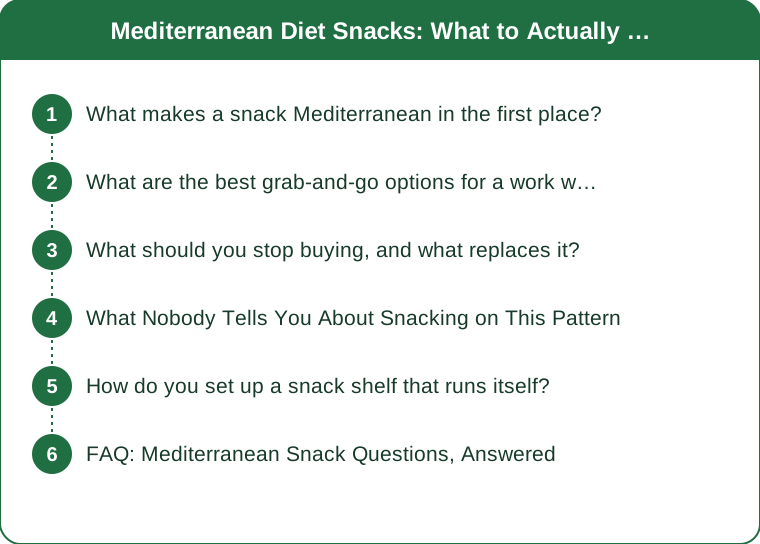
What makes a snack Mediterranean in the first place?
The same logic as the meals, shrunk: real food, a fat that earns its place, and produce doing half the work.
The operating template is produce plus an anchor. The anchor is a fat or protein — nuts, yogurt, cheese, hummus, olives, a boiled egg — and the produce is whatever is ripe. The anchor buys you two to three hours of satiety; the produce brings volume, fiber, and the micronutrients the pattern is famous for. Fruit alone is a fine bridge for 45 minutes; fruit plus almonds gets you to dinner.
Portion philosophy differs from American snacking in one important way: it is a small plate, eaten as a pause, not a bag accompanying a screen. The traditional cultures the diet is modeled on snack modestly — coffee and a few nuts, bread and tomato, fruit after a nap — and treat the evening meal as the anchor. Adopting the food without the punctuation misses half the mechanism.
Nothing is forbidden, but the center of gravity is unmistakable: things that were recently plants or animals, minimal packaging in between. If the snack’s ingredient list reads like a paragraph, it is drifting off-pattern regardless of what the front of the box claims.
What are the best grab-and-go options for a work week?
Eight that survive a desk drawer, a car, or a tote bag.
Nuts, pre-portioned. A small handful — about 23 almonds or 14 walnut halves — is the correct dose. Portion a big bag into small containers on Sunday, because the failure mode of nuts is not eating them, it is eating them by the half-cup.
Olives in snack pouches. Shelf-stable, salty, satisfying, and about as traditional as it gets.
Greek yogurt cups. Buy plain and add honey yourself; the pre-sweetened ones carry dessert-level sugar.
Hummus singles with whatever vegetable is in the fridge. Cucumber and carrots hold up; peppers travel better pre-sliced.
Whole fruit. The original portable snack. Late summer is peak season — peaches, plums, figs, and grapes are all at their best right now and need zero preparation.
A boiled egg. Six on Sunday, grab one at a time.
Whole-grain crackers with a wedge of cheese. Check the cracker label for actual whole grain first on the list.
Roasted chickpeas. Crunchy, cheap, and the closest legitimate answer to a chip craving.
Notice the pattern: every one of these is an anchor, produce, or both. Stock five of the eight and the 3pm decision is already made.
What should you stop buying, and what replaces it?
Four swaps close most of the gap.
Granola and cereal bars → nuts plus dried figs or dates. Most bars are candy with an oat alibi — check the sugar line and the syrup positions in the ingredient list. Two dates stuffed with almonds deliver the same sweet-chewy hit with fiber and no label fiction.
Chips → roasted chickpeas or olives. What you want from a chip is salt, crunch, and fat. Chickpeas cover crunch and salt; olives cover salt and fat. Between them the craving is answered.
Flavored yogurt cups → plain yogurt plus real fruit and honey. A flavored cup can carry 15 to 19 grams of sugar; plain with a teaspoon of honey and half a chopped peach lands around 8 and tastes like late summer instead of a lab.
Juice and smoothie bottles → the whole fruit itself. The bottle removes the fiber and the chewing, both of which are doing satiety work. Whole fruit plus water accomplishes what the $6 bottle advertises.
The economics run in your favor: the swap column costs less per serving in almost every case, with pre-portioned convenience formats being the exception you pay for deliberately in busy weeks. You are not adding discipline; you are changing the default within arm’s reach.

What Nobody Tells You About Snacking on This Pattern
The honest secret: the traditional version of this diet barely snacks at all. Meals in the source cultures are substantial and social, and the space between them is coffee, water, and patience. If you find yourself needing three snacks a day, the message is usually about your meals — a lunch that was a sad desk salad with no fat or protein will send the bill at 3:30. Fixing lunch shrinks the snack question more effectively than perfecting the snack does.
Second: hunger and heat-boredom are hard to tell apart in August. A late-summer afternoon slump often wants water, movement, or ten minutes outside more than it wants food. Drink first, decide in ten minutes — the classic advice survives because it keeps working.
Third, the afternoon snack has a job description: protect dinner. Its correct size leaves you genuinely hungry — not desperate — at the evening meal. A snack big enough to blunt dinner appetite inverts the pattern’s structure, where dinner is the day’s anchor and its vegetables do the heavy nutritional lifting.
And the one nobody says out loud: cheese is the place portion drift hides. It is legitimately on-pattern and also the densest thing on the snack shelf; the traditional serving is a small wedge alongside something, not a third of the block during a conference call. Pre-slicing when you shop is quiet insurance.
How do you set up a snack shelf that runs itself?
Fifteen minutes on Sunday, one shelf, one bowl.
The shelf — eye level, in this order of visibility: portioned nuts in small containers, olive pouches, roasted chickpeas, whole-grain crackers. Behind them, the backups: canned sardines for the adventurous, extra hummus singles.
The fridge zone — one clear bin: boiled eggs, cheese pre-sliced into wedges, hummus, washed grapes and cherry tomatoes, yogurt cups. The bin matters because visibility is the mechanism; food you can see gets eaten, and a snack that requires assembly loses to one that does not.
The counter bowl — whatever fruit the market was proudest of. Right now that is peaches and plums; in six weeks it will be apples and pears, and the bowl converts itself without a decision from you.
Place the less helpful options in exile: high shelves, opaque containers, or simply not in the house on a Tuesday. The research on proximity is unambiguous — distance and opacity reduce consumption without any felt deprivation.
Total cost to stock the system runs $25 to $35 a week for a household and replaces an easy $20 of vending, cafe pastries, and gas-station improvisation. The pattern’s reputation is fancy; its snack shelf is cheaper than the one it replaces.
FAQ: Mediterranean Snack Questions, Answered
How many snacks a day fit the pattern?
Zero to two, sized to your meal gaps. A single mid-afternoon snack suits most schedules; a small mid-morning one earns its place only when breakfast is early and light. Continuous grazing — even on olives and almonds — works against both the pattern’s structure and its results.
Is dark chocolate a Mediterranean snack?
A small square of 70 percent or higher alongside nuts is a well-established modern adaptation, and it is a better answer than pretending the craving does not exist. It is an accent, not an anchor — the two-row habit is a different food.
What about snacking at night after dinner?
The traditional pattern mostly does not, and late eating tends to be the least mindful eating of the day. If the evening genuinely requires something, fruit or a few nuts beats opening a package — but a satisfying dinner with enough fat and vegetables is the actual fix for a 9pm cabinet patrol.
Are protein bars ever acceptable on this pattern?
As travel and gym-bag equipment, occasionally, chosen for short ingredient lists and single-digit sugar. As a daily 3pm ritual, no — they are the exact processed-default habit the pattern replaces. The boiled egg costs a quarter as much and comes with no marketing.
This is general information, not medical advice.
TL;DR:
- The template is produce plus an anchor: fruit and nuts, vegetables and hummus, yogurt and honey, olives and cheese.
- Swap the bar-and-chip defaults for their Mediterranean equivalents — the craving math still balances and the cost drops.
- One intentional afternoon snack beats grazing; if you need three snacks, the real problem is a thin lunch.
- Build the environment once: a visible shelf, a fridge bin, a fruit bowl. Proximity does the discipline for you.
Stock the shelf this weekend and let 3pm stop being a negotiation. The pattern’s dinners get the press, but the snack shelf is where it actually gets easy.
Keep Reading
This article is for general informational purposes only and is not medical advice. Always consult a qualified health professional for guidance specific to you.