Mediterranean Diet Breakfast Ideas for Mornings You Actually Have
Quick Answer: A Mediterranean breakfast is built from whole grains, a protein that is not processed meat, a plant fat like olive oil or nuts, and produce — usually fruit in the morning. Greek yogurt with walnuts and fruit, or whole grain toast with olive oil and eggs, hits every mark in about four minutes. The pattern matters far more than any specific recipe, and there is no such thing as an official Mediterranean breakfast.
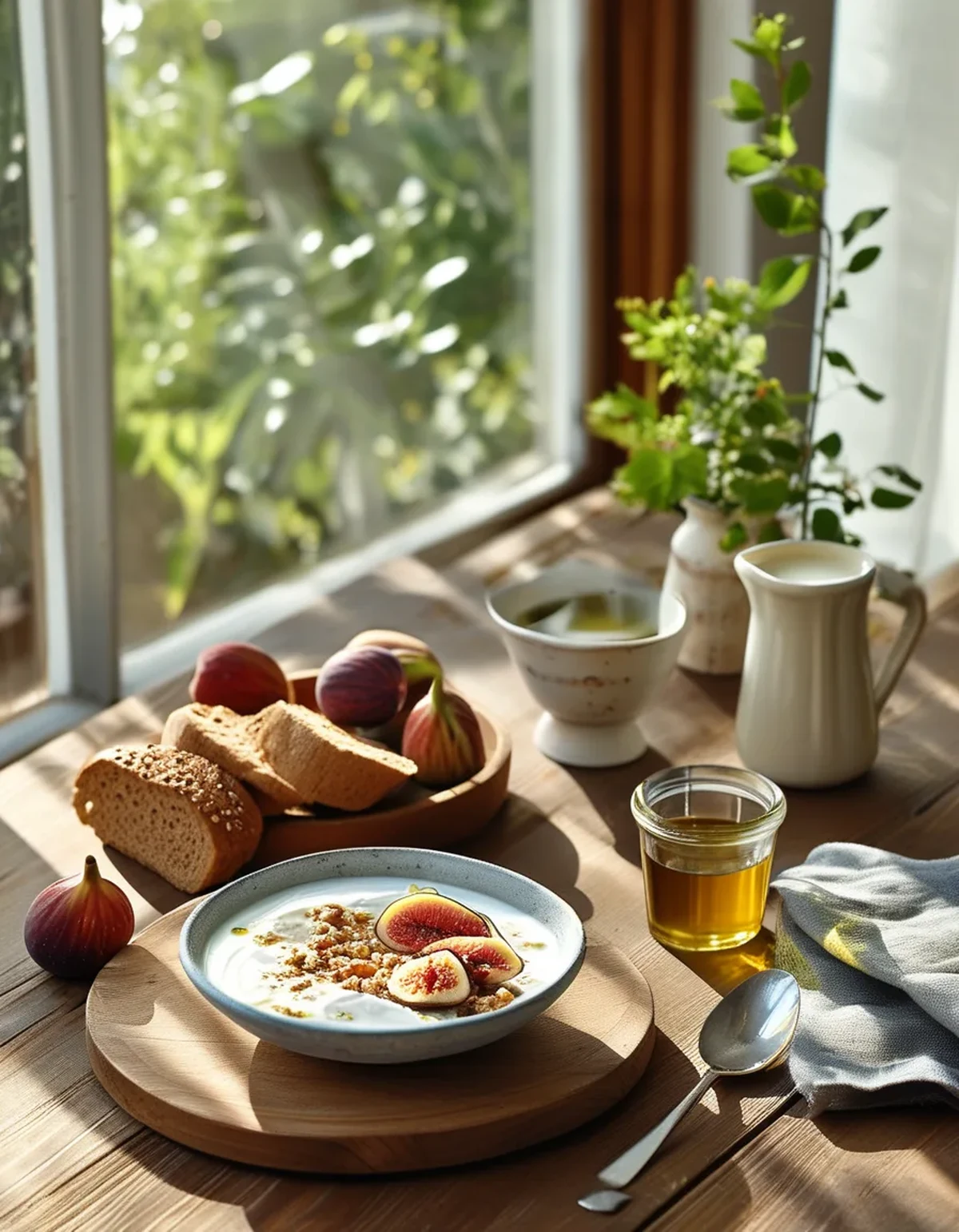
Search this topic and you get photographs of a table on a terrace: seven small dishes, fresh figs, a view of water.
That is a holiday, not a Tuesday. The principles behind it survive being compressed into four minutes at a kitchen counter, and that is the version worth learning.

What actually makes a breakfast Mediterranean?
Four components, and none of them requires a recipe.
A whole grain. Whole grain bread, oats, or a whole grain flatbread. The grain is a base rather than the star, which is the main structural difference from an American breakfast where cereal or pastry dominates the plate.
A protein that is not processed meat. Eggs, Greek yogurt, cottage cheese, feta, white beans, or nuts. Bacon and sausage are the specific exclusion here — red and processed meats are the category the pattern most consistently limits.
A plant fat. Olive oil, olives, nuts, seeds, or avocado. This is the component most often dropped in adapted versions, and it is doing a lot of the work in what makes the pattern distinctive.
Produce. Fruit in the morning most commonly, though tomatoes and cucumber at breakfast are entirely normal across the region and worth stealing.
What is notably absent: large amounts of added sugar, refined pastry as an everyday item, and heavy processed meats. Sweet pastry exists across the Mediterranean and is treated as an occasional thing rather than as a daily breakfast.
The honest caveat: the Mediterranean spans many countries with genuinely different breakfasts. Greek, Spanish, Lebanese, and Italian mornings look nothing alike. What research groups together is a broad dietary pattern, not a menu, which is exactly why it adapts so well.
What does a four-minute version look like?
Five options, none of which requires cooking beyond eggs.
1. Greek yogurt bowl. Plain full-fat or 2% Greek yogurt, a handful of walnuts, fruit, and a small drizzle of honey if you want it. About 20g of protein and it takes ninety seconds. This is the highest-value single swap for anyone currently eating cereal.
2. Toast with olive oil and tomato. Whole grain bread, good olive oil poured on rather than butter, grated or sliced tomato, salt. This is a genuine everyday Spanish breakfast, not a simplified version of one. Add an egg for protein.
3. Eggs with feta and greens. Two eggs scrambled with a handful of spinach and crumbled feta, cooked in olive oil. Four minutes, one pan, roughly 20g of protein.
4. Overnight oats, Mediterranean-style. Oats, milk or yogurt, chopped nuts, and fruit, assembled the night before. The nuts are what make it Mediterranean rather than generic, so do not skip them.
5. Leftovers. A slice of last night’s vegetable frittata, some white beans on toast, a piece of grilled fish with bread. Eating non-breakfast food at breakfast is standard across much of the region, and it removes the biggest weekday obstacle.
The realistic default: pick two of these and rotate. Breakfast variety is where good intentions go to die, and two reliable options beat seven aspirational ones.
Myth vs Fact: Mediterranean Breakfast Edition
Myth: It has to include fish. Fact: Fish at breakfast is common in some coastal areas and unheard of in others. The pattern’s fish recommendation is about weekly frequency, not about which meal it appears in. Two servings a week at any meal covers it.
Myth: Fruit juice counts as your fruit. Fact: Whole fruit and juice are not equivalent — the fiber that moderates the sugar response is exactly what juicing removes. Whole fruit is the pattern’s actual form.
Myth: Olive oil is too high in calories for breakfast. Fact: Olive oil is calorie-dense and that is not the same as a problem. A tablespoon is around 120 calories and it comes with a satiety benefit that flat-out replaces snacking two hours later for most people. The version of this pattern that strips out the fat is not the version that was studied.
Myth: You need to buy specialty ingredients. Fact: Yogurt, eggs, oats, nuts, bread, fruit, olive oil. Every item is in a normal supermarket at a normal price, and the imported-tin aesthetic is marketing.
Myth: Skipping breakfast is un-Mediterranean. Fact: Breakfast is genuinely light or skipped in many Mediterranean households — a coffee and something small. The pattern is not prescriptive about breakfast size.
How do I make this work on a real weekday?
Sunday assembly beats weekday cooking. Portion nuts into small containers, wash fruit, make a batch of overnight oats. The barrier at 7am is decisions, not time, and pre-made decisions are what survive.
Keep the four components visible. Yogurt at the front of the fridge, nuts on the counter, fruit in a bowl rather than in a drawer. Placement genuinely changes what gets eaten on a rushed morning.
Buy a decent olive oil and keep it by the stove. If it lives in a cabinet, it does not get used. A mid-range extra virgin is fine — the very expensive bottles are for finishing, not for a Tuesday.
Plain yogurt plus your own fruit beats flavored yogurt. Flavored yogurt commonly carries 12 to 20g of added sugar per cup, which turns the highest-value item on the list into a dessert.
Do not aim for seven days. Five weekday breakfasts following the pattern and two weekend mornings of whatever you want is a version people actually sustain for years. The all-or-nothing version lasts about three weeks, which is the single most common failure mode here.
FAQ: Mediterranean Breakfast Questions, Answered
Is oatmeal Mediterranean?
Oats are not a traditional Mediterranean grain, but they fit the pattern’s principles cleanly — a whole grain, minimally processed. Add nuts and fruit and it functions as a Mediterranean breakfast even if it is not a historically regional one.
Can I drink coffee?
Yes, and it is close to universal across the region. Coffee is not the issue — the 400-calorie sweetened coffee drink standing in for breakfast is a different thing entirely.
What about bacon and eggs?
The eggs are fine and well within the pattern. The bacon is the specific item this way of eating consistently limits. Swap it for feta, olives, or beans and you have kept everything you actually liked about the plate.
Is bread really allowed?
Whole grain bread is a staple, not a compromise. The pattern’s caution is about heavily refined white bread as a dominant everyday food, not about bread as a category.
TL;DR: Four components, two reliable recipes, and no terrace required.
- Whole grain + non-processed protein + plant fat + produce. That is the whole formula.
- Greek yogurt with walnuts and fruit is the single highest-value ninety-second breakfast.
- Do not strip out the olive oil or nuts — the fat is central to the pattern, not an indulgence within it.
- Plain yogurt plus your own fruit avoids the 12 to 20g of added sugar in flavored versions.
- Leftovers at breakfast are normal across the region and solve most weekday problems.
- Aim for weekdays, not every day. The all-or-nothing version is the one that fails.
Pick two breakfasts, buy the ingredients for both this week, and stop reading lists. The pattern rewards repetition, not variety.
This is general information, not medical or dietary advice.
Keep Reading
This article is for general informational purposes only and is not medical advice. Always consult a qualified health professional for guidance specific to you.