How to Order Mediterranean-Style at a Restaurant That Is Not Mediterranean
Quick Answer: Order a vegetable-forward starter, choose fish or legumes over red meat, ask for olive oil and lemon on the side rather than dressing, and treat bread as part of the meal rather than a free prelude. Those four moves reproduce most of the Mediterranean pattern’s structure anywhere, because the pattern is about proportions on the plate rather than about specific Mediterranean foods.
The advice tells you to eat like people on a Greek island, and you are at a chain restaurant off a highway in Ohio.
The good news is that the pattern is portable. The foods are not the point - the ratios are.

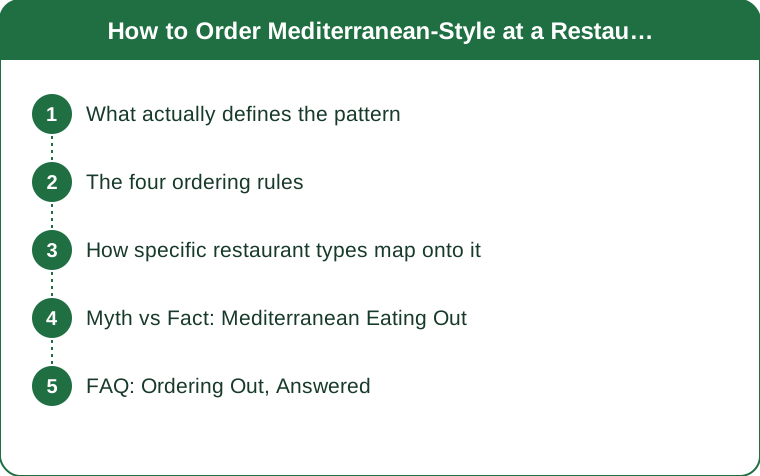
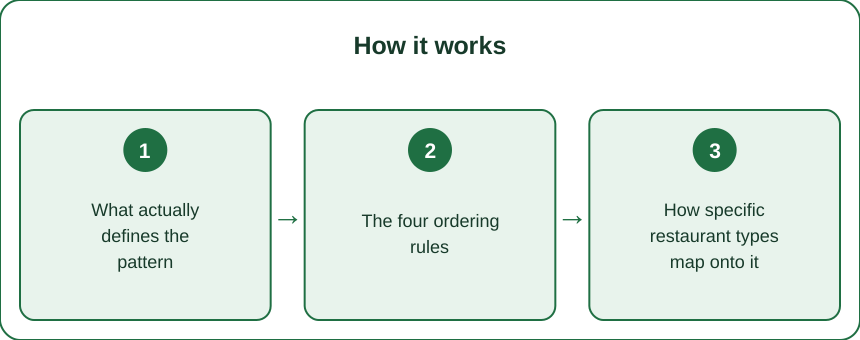
What actually defines the pattern
Vegetables occupy the largest share of the plate, across nearly every meal. This is the single most consistent feature of traditional Mediterranean eating and the one most easily reproduced anywhere.
Olive oil is the primary added fat, rather than butter, cream, or industrial seed oils used for deep frying. Quantity matters here - traditional intakes were substantial, not minimal.
Protein leans toward fish, legumes, and poultry, with red meat appearing occasionally rather than daily. The frequency is the variable, not the elimination.
Whole grains and bread are present but proportional, eaten as part of a meal alongside vegetables and protein rather than as a large solo course.
And the meal structure itself is part of it - eating slowly, at a table, usually with other people. That is harder to reproduce in a car park and it is not nothing, given that eating rate influences how much you eat.
None of this requires Mediterranean ingredients. A plate of grilled chicken, a large salad with olive oil, and a piece of bread is structurally Mediterranean regardless of what the restaurant calls itself.
The four ordering rules
One: order a vegetable starter before you order anything else. A side salad, a vegetable soup, or grilled vegetables. Ordering it first, rather than deciding after the main, is what makes it happen - and it changes what you want from the main course.
Two: choose fish or legumes when they exist, poultry when they do not. Grilled or baked rather than breaded and fried, which is usually the whole difference in both fat quality and quantity.
Three: ask for olive oil and lemon or vinegar on the side. Most kitchens have both, and restaurant dressings are typically the largest hidden source of both calories and low-quality fat in an otherwise reasonable meal.
Four: decide about the bread when it arrives, not after three pieces. Bread is genuinely part of Mediterranean eating; a basket eaten absently before the food arrives is not. Take one piece, use it with the meal, and move the basket.
A fifth, optional rule: order a starter and a side rather than a main, which at most American restaurants produces a more balanced plate and a more reasonable portion than any single entree.

How specific restaurant types map onto it
Steakhouse: order the fish if there is one, otherwise the smallest steak, and spend the rest of the order on vegetable sides. Steakhouses usually have excellent vegetable sides that nobody orders.
Diner: eggs are a solid choice, with a side of tomatoes or a salad instead of hash browns, and whole grain toast where available. Breakfast served all day is often the best structural fit on the whole menu.
Italian-American: ask for the pasta portion as a starter size, add a grilled protein and a salad. The cuisine is nominally Mediterranean and the portioning is emphatically not.
Mexican: beans are the strongest thing on most of these menus. Grilled protein, black or pinto beans, salsa, guacamole, and a corn tortilla is a structurally excellent meal.
Fast casual: grain bowls are the easiest win available - choose the base, load vegetables, pick grilled protein, and take the dressing on the side.
Airport or highway: a sandwich with the second slice of bread removed, plus a piece of fruit and nuts, is not glamorous and holds the shape of the pattern reasonably well.
Myth vs Fact: Mediterranean Eating Out
Myth: you have to find a Mediterranean restaurant. Fact: the pattern is a set of proportions. A steakhouse plate rearranged toward vegetables and fish is closer to the pattern than a plate of fried calamari and creamy pasta at a Greek-themed restaurant.
Myth: olive oil should be minimized to save calories. Fact: traditional intakes were high, and olive oil is one of the components most consistently associated with the diet’s measured benefits. The fat to reduce is the deep-frying oil, not the drizzle.
Myth: bread is off-limits. Fact: bread is a genuine part of the pattern. The issue is a basket eaten before the meal in addition to everything else, not bread itself.
Myth: a salad is automatically the healthy order. Fact: restaurant salads with creamy dressing, croutons, cheese, and fried chicken frequently exceed the burger. Ask for the dressing on the side and you have removed most of the problem.
Myth: wine is required for the benefits. Fact: the evidence for alcohol as a necessary component is weak and has been repeatedly questioned. The vegetables, olive oil, legumes, and fish carry the pattern.
FAQ: Ordering Out, Answered
What is the single most useful rule?
Order a vegetable starter first, before deciding on the main. It changes both the composition of the meal and how hungry you are when the main arrives.
How often can I eat red meat and still follow the pattern?
Traditional patterns include it a few times a month rather than a few times a week. Frequency, not elimination.
Is asking for dressing on the side really worth it?
It is one of the highest-impact single requests available, since restaurant portions of dressing are typically far larger than what you would use yourself.
What about dessert?
Fruit is the traditional answer, and shared dessert is the practical one. Neither is a problem at the frequency most people actually eat out.
Does this work at chain restaurants?
Yes - most chains publish nutrition information and nearly all have grilled options and vegetable sides. Structure is available almost everywhere if you order for it.
Is olive oil at a restaurant the same quality?
Usually not extra virgin, and often a blend. It is still a better choice than most alternatives on the table, and quality matters more at home where you use most of your oil.
TL;DR:
- The Mediterranean pattern is proportions, not ingredients - it reproduces at almost any restaurant.
- Order a vegetable starter first, choose fish or legumes over red meat, get olive oil and lemon on the side, and decide about bread deliberately.
- A starter plus a side often beats an entree for both balance and portion size.
- Beans at a Mexican restaurant and eggs at a diner are among the strongest available options.
- Olive oil is not the fat to minimize; deep-frying oil and creamy dressings are.
One request - dressing on the side - changes more about a restaurant meal than almost anything else on the menu.
Keep Reading
This article is for general informational purposes only and is not medical advice. Always consult a qualified health professional for guidance specific to you.